
Historic Solar Eclipse Captivates Millions Across UK and Europe
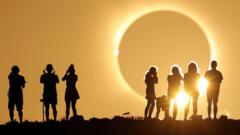
Historic Solar Eclipse Captivates Millions Across UK and Europe
A remarkable celestial phenomenon swept across the continent as a solar eclipse UK Europe event drew the attention of millions of observers. The extraordinary alignment of the Moon between the Earth and Sun created one of the most talked-about astronomical occurrences in recent memory, with observers from various regions witnessing different intensities of this natural spectacle.
Exceptional Coverage in Southwest England
Cornwall, located in the southwestern tip of England, experienced particularly dramatic eclipse conditions. The lunar shadow obscured more than 95% of the solar disk across the region, transforming daylight into an otherworldly twilight atmosphere. Residents and visitors gathered at designated viewing areas, equipped with specialized solar glasses and telescopes, to observe this rare astronomical event unfolding above their heads.
The near-total obscuration created a noticeable temperature drop and caused widespread behavioral changes among local wildlife. Birds ceased their daytime activities, and insects retreated to shelter, responding to the sudden dimming of daylight. These biological reactions provided additional fascination for observers interested in understanding how nature responds to such dramatic changes in solar radiation.
Spain Witnesses Complete Totality
While the UK experienced a partial eclipse, certain regions of Spain were positioned directly in the path of totality, where the Moon completely blocked the Sun's disk. These locations experienced the full majesty of a total solar eclipse, with the solar corona becoming visible to the naked eye during the brief period of totality. The Spanish regions fortunate enough to be in the totality zone witnessed approximately two to three minutes of complete darkness during daylight hours.
Observers in Spanish territories described the experience as transformative and awe-inspiring. The sudden darkness and the appearance of stars during midday created an atmosphere of wonder that transcended typical astronomical interest. Thousands of tourists traveled specifically to Spain to witness this historic moment, making it one of the most popular eclipse destinations in recent years.
Continental Significance and Preparation
The solar eclipse UK Europe event represented the first total eclipse visible from the European continent in nearly two decades. Scientists and astronomical organizations across the region coordinated extensive public outreach programs to ensure safe viewing practices. Educational institutions developed curricula around the eclipse, and museums hosted special exhibitions explaining the physics behind lunar-solar alignments.
Governments and local authorities implemented emergency protocols to manage the expected surge in visitors to prime viewing locations. Transportation networks experienced increased demand as people traveled to optimal observation points. Hotels and accommodations throughout the affected regions operated at maximum capacity, with many facilities reporting bookings months in advance.
Scientific Research and Observations
Beyond public spectacle, the eclipse provided valuable opportunities for scientific research. Astronomers utilized specialized instruments to study the solar corona, investigate solar wind behavior, and gather data about the Sun's upper atmosphere. Universities and research institutes positioned equipment at multiple locations to capture comprehensive data across different geographic vantage points.
The solar eclipse UK Europe event offered researchers unprecedented opportunities to conduct simultaneous observations from various latitudes and longitudes. This distributed approach allowed scientists to build a more complete understanding of solar phenomena and test theoretical models of the Sun's complex structure and behavior.
Global Context and Future Events
This remarkable eclipse joined a series of significant astronomical events that capture public imagination and inspire interest in science and astronomy. Climate scientists noted the temporary reduction in solar radiation during the eclipse period, collecting data that contributes to understanding solar influence on Earth's atmospheric systems.
Future solar eclipses will occur, but their visibility from specific regions follows predictable but infrequent patterns. The combination of the Moon's orbit, Earth's rotation, and orbital mechanics means that total solar eclipses visible from any particular location occur roughly once every 375 years on average. This rarity underscores why the solar eclipse UK Europe event generated such widespread enthusiasm and extensive preparation among observers.
Public Impact and Legacy
The eclipse created a shared experience that unified communities and sparked conversations about humanity's place within the cosmos. Social media platforms overflowed with photographs, observations, and personal accounts from individuals across the continent. Schools incorporated eclipse observations into their educational programs, potentially inspiring the next generation of astronomers and scientists. The memorable nature of the solar eclipse UK Europe phenomenon ensures it will remain a cherished memory for those fortunate enough to witness this extraordinary natural display.


